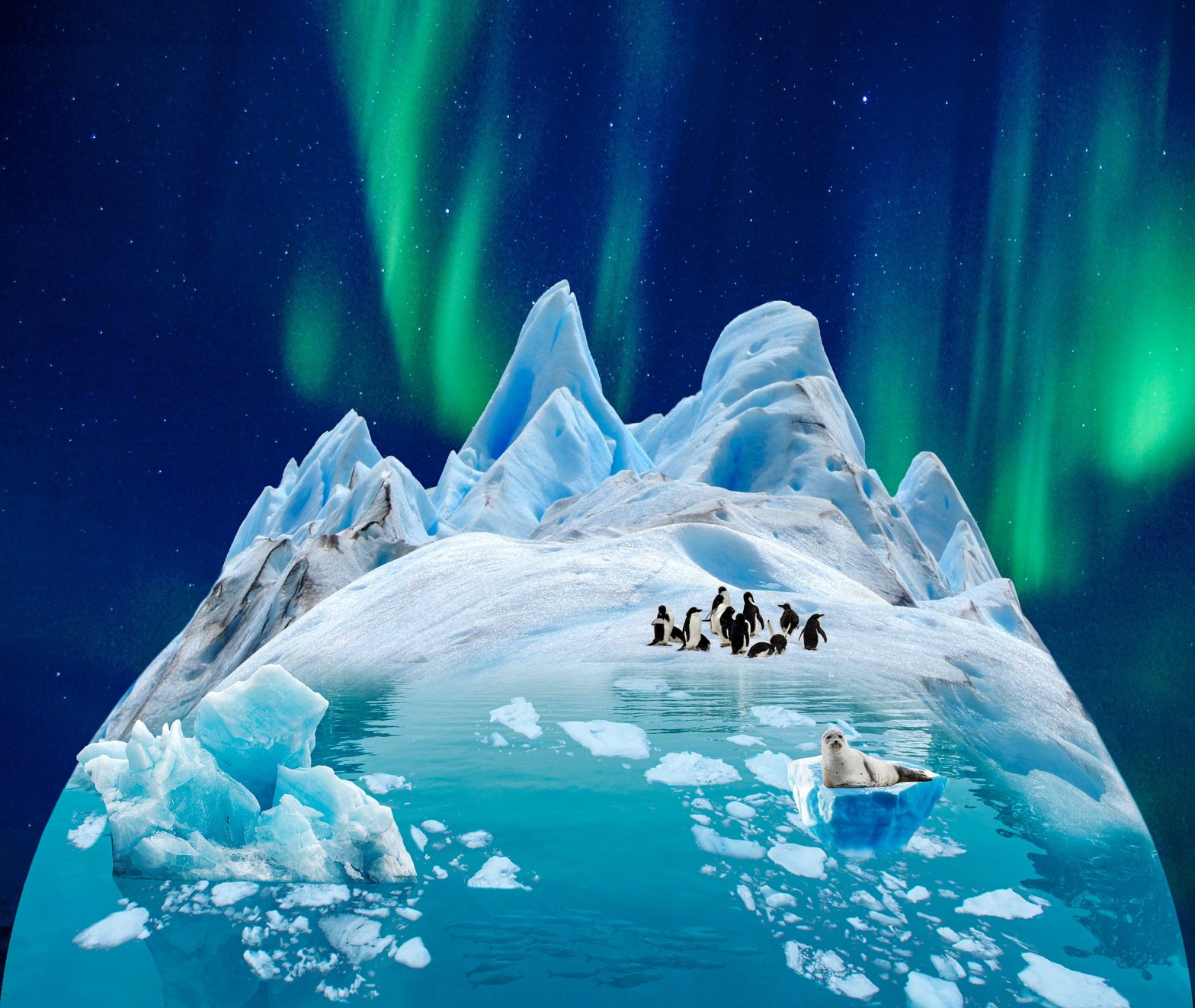
Over View: The Antarctic’s highest point is 2800m at the south-pole. In 1933 The Australian Antarctic Territory (AAT) claims two parts of the Antarctic. The International Whaling Commission (IWC) took effect in 1946. 1959 The Antarctic Treaty System (ATS) was enforced in alignment with United Nations Convention on the Law of the Sea (UNCLOS). Conservation of Antarctic Seals formed in 1972. 1980 The Whale Protection Act was introduced. 1991 The introduction of the Madrid Protocol (MADRID) was introduced and the Australian Whale Sanctuary (AWS) was established in 1999.
Antarctica the largest ice mass in the world, site of 27-29 year round Research Stations of multiple Nations and Nationals.
The only indigenous population is located on Peter 1 Island this is located 90°W parallel to the South Pole.
Australia Antarctic Territory (AAT) come about on the 7th February via the British putting territory authority over the claim in Antarctic to our Commonwealth Government and was introduced in 1933 which predates that of the signing of the Antarctic Treaty System (ATS) by two decades. AAT does not apply to agreements related to Russian drilling currently.
To date the Australian Government with a sovereignty claim has not attempted to enforce national laws against Japanese vessels seen whaling in the AAT EEZ as on signing the ATS agreed to the suspension of claim of territory within the Antarctic EEZ in accordance to following the practice of all other United Nations in only exercising jurisdiction over its own nationals or those subject to Australian Law.
Australia’s claim in the Antarctic is 60° Parallel of the South Pole and between 45°E to 160°E, the second section of claim is 136°E to 142°E longitudes’. Australia still maintains the right to explore and exploit the seabeds and water columns within the EEZ; originally sovereign country’s EEZ was 3 nautical miles off shore.
Neither this claim nor any other is recognised by Russia, Japan, China or America that are only bound by UN UNCLOS. The only nations that do recognise this sovereign claim are Norway, New Zealand, Australia, France and UK.
Twenty-one of 28 Antarctic nations have made no claims for territory, with only seven making a total of 8 claims of sovereign territorials by 1961 below 60° S Parallel with zero having indigenous populations.
After World War 2, America, China and Japan renounced claim to Antarctic land/waters returning it to neutral waters and land.
The Exclusive Economic Zone (EEZ) is the zone that leading out from the mainland, in Antarctic the EEZ is a distance of 350kms or 200 nautical miles out.
1 April 2008 the decision was announced that Australia would now have EEZ rights to 2.5 million square kilometers of seafloor the tongue of shelf on the Kerguelen plateau that extends south of Heard Island inside the treaty boundary.
The United Nations Convention ‘Law of the Sea’ (UNCLOS) was introduced for greater maritime regulations of fishing and mammals in alignment to laws of UN, these laws outlining ‘Law of the Sea’ cover all aspects including legal status of the territorial sea, of the air space over the territorial sea and of its bed and subsoil and reservation of the high seas for peaceful purposes. This is comprises of 320 Articles and 9 Annexes.
All United Nations that signed the ATS are bound by the UNCLOS within Antarctic and international waters.
Antarctic Treaty System (ATS)
Article 1 – Area to be used for peaceful purposes only; military activity, such as weapons testing, is prohibited, but military personnel and equipment may be used for scientific research or any other peaceful purpose;
Article 2 – Freedom of scientific investigation and cooperation shall continue;
Article 4 – The treaty does not recognize, dispute, nor establish territorial sovereignty claims; no new claims shall be asserted while the treaty is in force;
Article 7 – Treaty-state observers have free access, including aerial observation, to any area and may inspect all stations, installations, and equipment; advance notice of all activities and of the introduction of military personnel must be given;
Article 11 – Disputes to be settled peacefully by the parties concerned or, ultimately, by the International Court of Justice;
Reserved claims on territory within the Antarctica are currently held by America and Russia only but not an active option while there is an ATS. All drilling and mining in the Antarctic in relation to the above counties won’t be reviewed to 2048.
Australian Whale Sanctuary (AWS) established in 1999 to protect dolphins and whales from being killed, injured or hunted by fishing vessels unless permitted or authorised under the Environment Protection and Biodiversity Conservation Act 1999. This sanctuary is located adjacent to the Antarctica. Australian Naval and Custom vessels have the right within this area to arrest and board any vessel under the AAT.
The regulation of whaling was excluded from the ATS, that was added to the by contracting parties and Australian domestic law carefully recognises the general rule that Australian law will not be enforced against foreign countries operating under an authority granted by a party to the ATS.
Australia will not take action against the Japanese under this order because that would be an act of war, not under Australian law, but according to the law of most other countries in the world.
Any Government from any country such as Japan can permit contractors for whaling granted each year, that are not recognised by Madrid or the ATS, authorising the kill, take for scientific research purposes subject to the restrictions of the Contracting Government authorising the special permit, recognised by the IWC.
Japan could continue whaling anywhere in the Antarctic they like by withdrawing from the International Whaling Convention. They would not be bound by moratorium on commercial whaling, and therefore other nations ultimately would be powerless to lawfully stop Japan for whaling on the high seas. Currently Japan is happy to continue to permit whaling by its nationals and can only be interfered with in local domestic waters of nationals and/or within the AWS.
International Whaling Commission (IWC)
IWC was introduced in 1946 setup under the International Convention for the purpose of the regulation of whaling on the high seas.
The conventions main task is to monitor the stocks of whaling for orderly development of the whaling industry. They are to review and revise as necessary the measures laid down by the convention which governs the conduct of all whaling throughout the world.
The IWC set the limits and size of the catch each year, they organise the placement of Whale Sanctuaries where required, agreed on by the member nations also they determine the length of time that the whaling season is open/closed each year.
They prohibit the capture of suckling calves and female whales that are accompanied by the calves. Each season members are required to submit reports on capture, statistical and biological records as required.
In addition, the commission encourages, co-ordinates and funds whale research, publishes the results of scientific studies on subjects such as the humaneness of the killing operations.
Any member of the UN can join the IWC that is represented by a commissioner assigned by the IWC, usually serving three years with that member.
Madrid Protocol 1991 (MADRID)
The Madrid is an addition to the ATS adopted by all nations and parties which provides for comprehensive protection of Antarctica, as the last greatest wilderness on earth.
Introduced in 1991 the protocol consists of 6 Annex breakdowns covering the subjects:
Environmental Impact Assessment
Conservation of Antarctic Fauna and Flora
Waste Disposal and Waste Management
Prevention of Marine Pollution
Liability for Environmental Emergencies
As with the ATS any member that has signed the Madrid may however withdraw from the protocol if any amendments are made thereafter.
In Summary:
All nations that have signed the ATS requirements and therefore are abided to follow in accordance this treaty overrides any other treaty while enforced.
The Main objective of the ATS is to ensure in the interests of all mankind, that Antarctica shall continue forever to be used for peaceful purposes and shall not become the scene or object to international discord. The Treaty forbids military interaction of war machines but not personnel.
Antarctica is comprised of non-permanent nationals from sovereignty countries, Antarctic is not a sovereignty its self, all territory claims are suspended according to ATS while enforce but are still governed by that sovereignty.
Conservation Groups need to rethink their approach/strategies’ to dealing with and/or being heard via the process of diplomacy approach through government or IWC, not through attacks that can be seen as forms of piracy (approaching or boarding vessels, towing ropes in the attempt to cause destruction); interference (navigating in the path or seaway of another vessel); pollution (destruction of vessels and/or by using projectiles other than water) or defamation of a nation or company in the means of trying to bankrupt via hostile means.
The entire above are prohibited within the Antarctic according to ATS UNCLOS with sea safety to be observed at all times directed by Maritime Sea Authority (MSA). Domestic governments are required by law to maintain harmony within their own waters and the high seas, including Antarctic waters in relation to their own citizens and people that come under judicial territory to in upholding such laws.
In relation to vessels on the sea local or international the only authorised divisions that can inspect (notice must be given unless good reason given), board or interfere with another vessel are Customs and Navy.
Any other ship that takes onboard the duties of Customs or Navy vessels is in breach of the AAT in Australia and UN ATS UNCLOS. This by other members is seen as a threat and a means to invoke hostile intentions between nations, clearly illegal and may be seen as an Act of War if continues unchecked.
The Maritime Authority should impose domestic or international restrictions on conversation ships in relation to areas in which they can operate when it comes to environment protection, including dry-docking any vessels that a repeat offenders to breaching high sea laws.
BJ Hutton
 Protonumus